
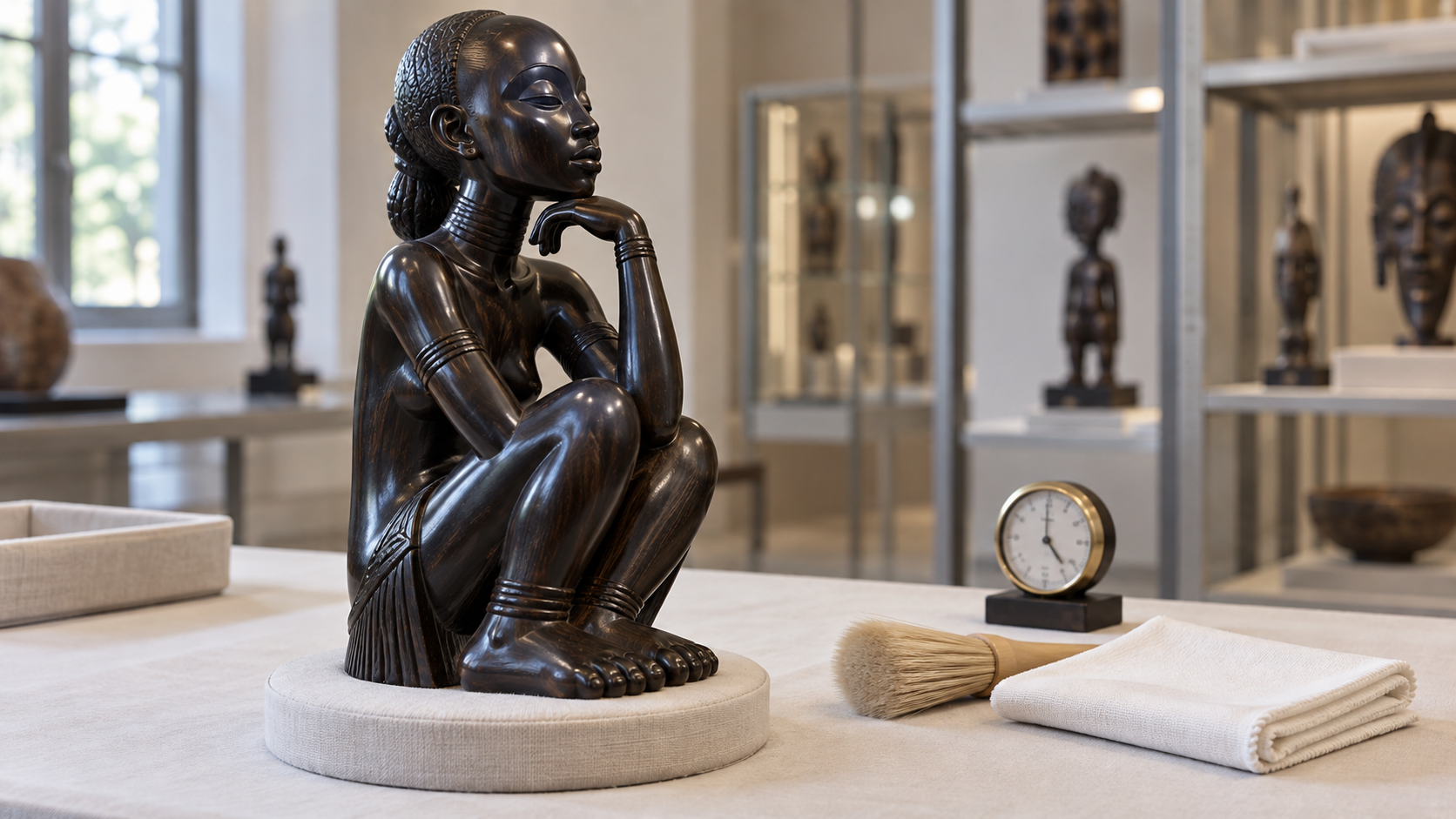
How to Care for Ebony Sculpture: Prevent Cracks, Dryness and Dullness brings material, craftsmanship and responsible collecting into one practical guide. It replaces generic claims with observable details and useful questions.
Stability matters more than a perfect number
Wood continues to exchange moisture with the air after it becomes sculpture. Sudden change is usually more dangerous than a mildly imperfect but stable environment. Moving an object from humid storage into a very dry heated room can make the surface and core shrink at different rates. Keep the piece away from radiators, fireplaces, air-conditioning vents and damp walls. After transport between climates, let the packed object acclimatise gradually. A simple humidity monitor is useful, but aggressive correction can create the very swing you are trying to avoid.
Display light without heat
Direct sunlight warms the surface and may change both colour and finish over time. Indirect daylight or controlled artificial light is safer. A soft side light reveals dark volume beautifully without requiring high intensity. Check the sun’s path at different hours; a location that is safe in the morning may receive harsh afternoon light. A lamp should never sit close enough to warm the sculpture.
Dust gently and dry
Use a clean, very soft brush or dry microfibre cloth. Support the piece and work slowly, following the form without pulling on narrow projections. Never spray cleaner onto the object. Avoid alcohol, glass cleaner, household furniture polish and wet cloths; they can dissolve wax, leave residue or lodge moisture in recesses. A vacuum can catch a fragile detail even with a brush attachment. Sticky contamination should be assessed with knowledge of the original finish.
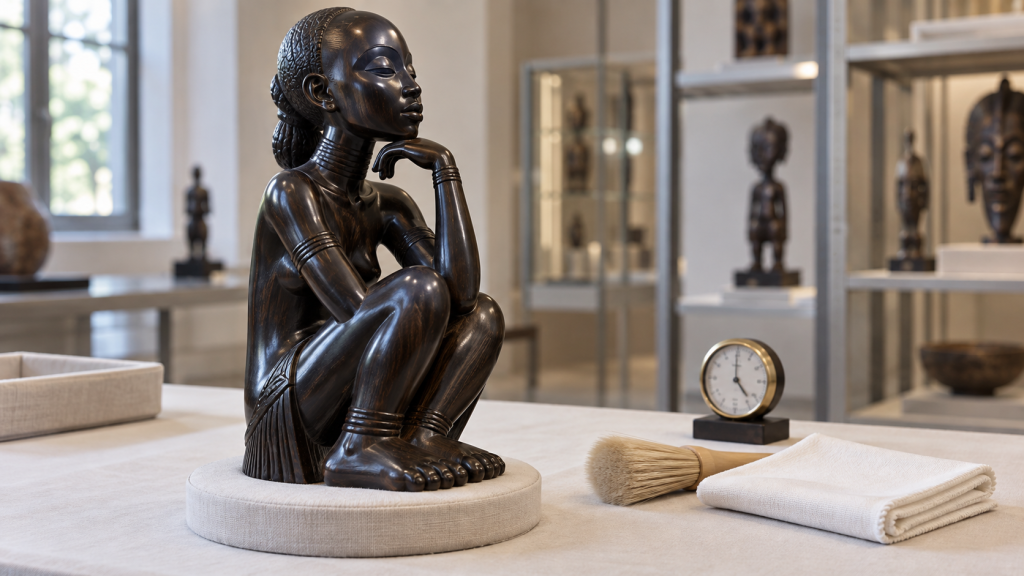
A text-free editorial image created specifically for this Africa Ebony journal story.
Oil far less often than you think
A dull appearance does not automatically mean dry wood. Dust, old wax or lighting may be responsible. Repeated oiling can produce a sticky surface that attracts dirt and may darken the material excessively. Identify the existing finish first. If the maker recommends a specific product, test the smallest possible amount in a hidden place and follow the instructions. Cooking oils are unsuitable because they can oxidise and become rancid. Valuable or mixed-media works belong with a conservator.
Handle the strongest mass
Plan the route before lifting. Use two clean hands on the strongest body and base, never a head, horn, hand or projecting ornament. The display surface must be level and safely away from an edge. In homes with children or pets, a professional reversible restraint may be appropriate. Packing material should support the sculpture without pressing on vulnerable details, and damp plastic or acidic paper should not touch the finish.
Respond to a crack calmly
Photograph a new crack from the same angle, record the date and monitor its width. Do not inject household glue, clamp the sculpture or flood it with oil. First stabilise the environment. An old closed check may be part of normal material behaviour; an opening crack, movement or sound requires professional assessment. Good conservation prioritises structural stability and minimal reversible intervention rather than making every trace of age invisible.
A practical checklist for collectors
Read the listing twice: first for form, then for facts. On the first pass, consider silhouette, proportion, centre of gravity, negative space and the way the sculpture changes across viewpoints. On the second, record dimensions, weight, wood description, maker or workshop, country of production, finish, condition and every stated repair. A single front image is never enough. Request the reverse, underside, side profiles and a close view under soft light. If words and photographs do not agree, resolve the difference before payment. This short discipline prevents impulse purchases and makes comparison fair.
After delivery, open the package without pulling on narrow details. Match the inventory number, measurements and condition with the invoice, then make a clear photographic record in indirect daylight. Place the work on a stable surface away from sun, heating, air conditioning and local moisture. For routine cleaning, use only a soft dry brush or clean microfibre cloth unless the maker or a conservator specifies otherwise. Keep the invoice, certificate, permits, photographs and provenance correspondence together. That file becomes part of the object’s history and supports future care, insurance or transfer.
Before you decide: look slowly and ask clearly
Ebony sculpture rewards slow looking. Begin at a distance, where the silhouette and balance are easiest to judge, and then move closer to read the meeting of planes, the direction of grain and the evidence of tools. Turn the work mentally through the photographs rather than treating the front as the entire sculpture. Notice whether a polished highlight clarifies volume or merely hides an uneven surface. Small natural variations can make an object more individual, but every crack, repair, separate component and applied coating should be described honestly. If the seller cannot answer a technical question immediately, a careful follow-up is more reassuring than an invented certainty.
Also consider the life the object will have after purchase. Identify a stable display position, measure it, check the light through a full day and plan how the piece will be lifted and dusted. Think about whether the scale suits the room and whether the subject will still hold your attention when decorative trends change. Good collecting connects visual pleasure with stewardship. It supports identifiable makers, respects finite material and preserves records that allow a future owner to understand what the object is. The strongest choice is rarely the one with the loudest story. It is the sculpture whose material, workmanship, documented origin and emotional presence remain convincing when examined together.
Frequently asked questions
Does a perfectly black colour prove that the wood is ebony?
No. Colour is only one clue. It must be considered alongside grain, density, the underside, finish, maker information and provenance. Other woods can be stained, while genuine ebony may contain brown or pale variation.
Are small surface variations defects?
Not necessarily. Natural figure, controlled tool marks and slight handmade asymmetry belong to wood and handwork. An active crack, loose joint or sticky coating is different and deserves investigation.
What documents should accompany the work?
At minimum, retain an invoice and object record stating title, maker or workshop, place of manufacture, material, dimensions, weight, unique identifier and known provenance. International movement may require additional current permits.
Editorial note: Species status and timber-trade rules vary by origin and can change. Consult current official sources and a responsible seller before international shipment.