
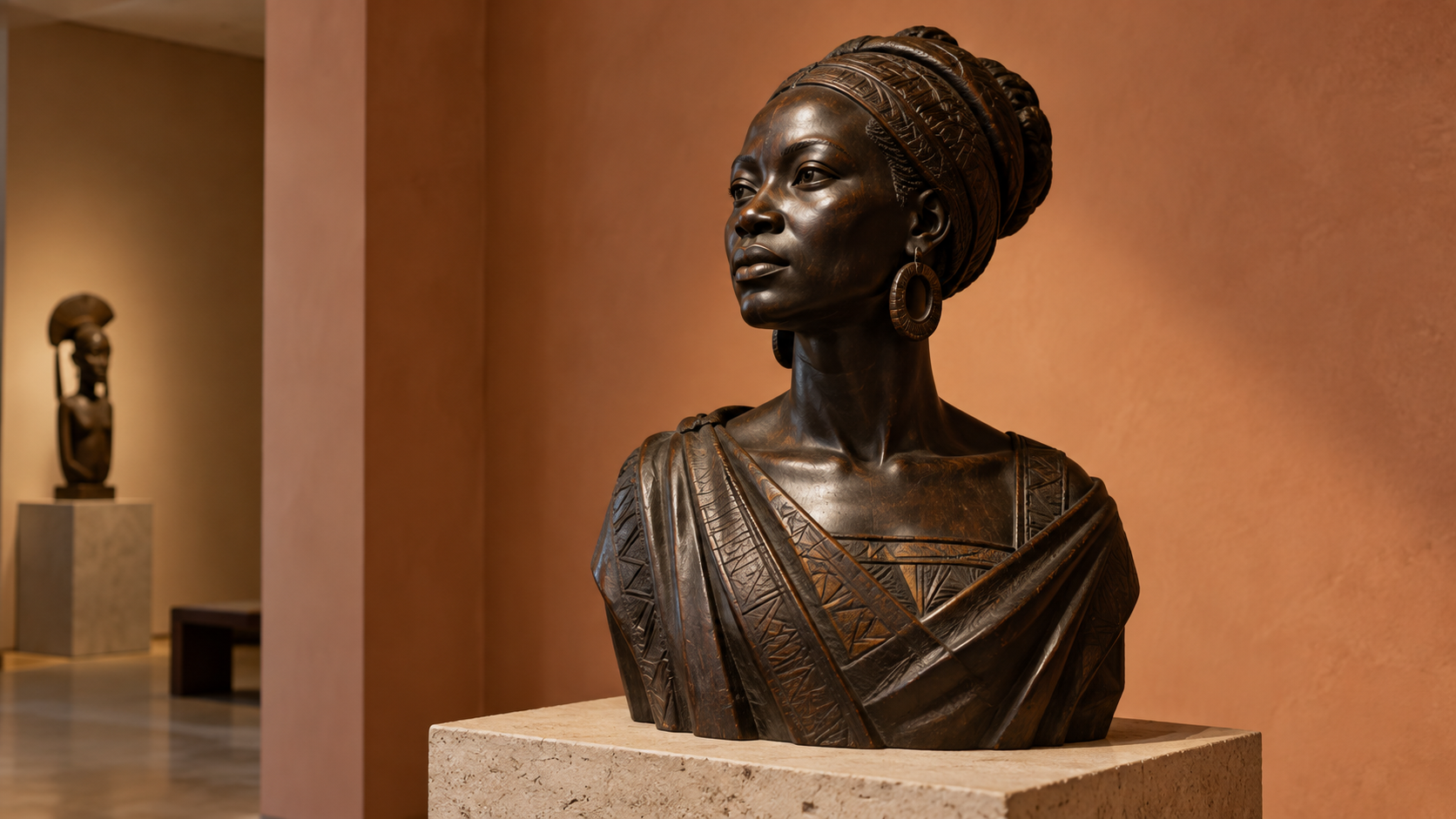
The Female Figure in Contemporary African Sculpture brings material, craftsmanship and responsible collecting into one practical guide. It replaces generic claims with observable details and useful questions.
One continent, many visual languages
“African art” does not describe a single style. The continent contains hundreds of distinct histories, communities and contemporary practices. A hairstyle, ornament or posture can carry different meanings in different places. Responsible interpretation starts with the maker, title and location. When those facts are unavailable, we can discuss what is visible—line, balance, expression, rhythm and light—without inventing a ritual identity. Honest uncertainty protects the real story of the work.
Dignity through posture and stillness
An elongated stance, level shoulders or a lifted chin can create quiet authority without theatrical movement. A small change in the neck can transform the relationship between figure and viewer. Centre of gravity also communicates: a grounded pose feels stable, while a subtle lean can suggest intimacy or reflection. These observations are visual readings, not universal cultural definitions. The artist’s own words remain the best guide.
Portrait and archetype
Some sculptures record the features of a specific sitter; others simplify the face into a broader formal idea. Closed eyes may feel contemplative to one viewer, but should not be assigned a ceremonial meaning without evidence. Perfect symmetry is not always the goal. Slightly different sides can make a face feel present and alive. Ebony’s fine grain allows tiny shifts in lid, lip and cheek to remain legible.
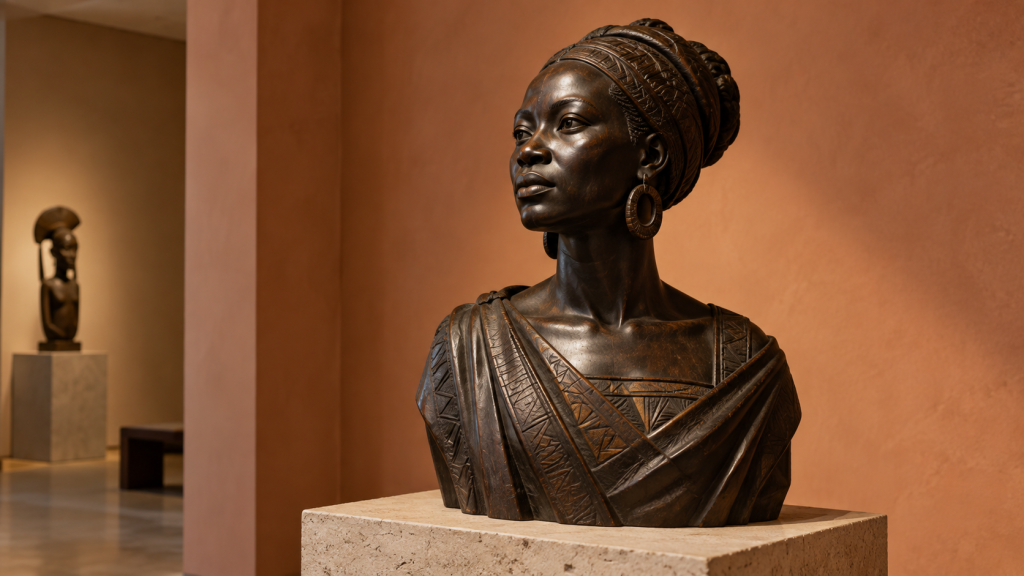
A text-free editorial image created specifically for this Africa Ebony journal story.
Hair, dress and ornament as structure
Hair and jewellery build silhouette and rhythm as much as they decorate. Repeated grooves break light against a smooth face; carved cloth can direct the eye across a torso. In a documented work, these elements may refer to a precise time and place. In a contemporary piece they may be personal combinations. A strong product description observes closely while remaining within the evidence.
Material is not identity
Ebony has a powerful dark surface, but the colour of wood should not be collapsed into the identity of the person represented. The timber has its own natural and economic history; the figure results from an artist’s choices. Thoughtful criticism asks how light moves, why one passage is raw and another polished, who made the work and how it entered the market. Naming and compensating the artist are part of respecting the human subject.
Display and collect with respect
Place a portrait near eye level against a calm background so its gaze and silhouette remain clear. Record the title, artist, place, date, material and seller. Ask whether the work is a portrait, an inspired form or part of an edition. Avoid generic names that turn an African woman into an exotic type. Personal response is welcome, but it should sit beside—not replace—the documented voice of the maker.
A practical checklist for collectors
Read the listing twice: first for form, then for facts. On the first pass, consider silhouette, proportion, centre of gravity, negative space and the way the sculpture changes across viewpoints. On the second, record dimensions, weight, wood description, maker or workshop, country of production, finish, condition and every stated repair. A single front image is never enough. Request the reverse, underside, side profiles and a close view under soft light. If words and photographs do not agree, resolve the difference before payment. This short discipline prevents impulse purchases and makes comparison fair.
After delivery, open the package without pulling on narrow details. Match the inventory number, measurements and condition with the invoice, then make a clear photographic record in indirect daylight. Place the work on a stable surface away from sun, heating, air conditioning and local moisture. For routine cleaning, use only a soft dry brush or clean microfibre cloth unless the maker or a conservator specifies otherwise. Keep the invoice, certificate, permits, photographs and provenance correspondence together. That file becomes part of the object’s history and supports future care, insurance or transfer.
Before you decide: look slowly and ask clearly
Ebony sculpture rewards slow looking. Begin at a distance, where the silhouette and balance are easiest to judge, and then move closer to read the meeting of planes, the direction of grain and the evidence of tools. Turn the work mentally through the photographs rather than treating the front as the entire sculpture. Notice whether a polished highlight clarifies volume or merely hides an uneven surface. Small natural variations can make an object more individual, but every crack, repair, separate component and applied coating should be described honestly. If the seller cannot answer a technical question immediately, a careful follow-up is more reassuring than an invented certainty.
Also consider the life the object will have after purchase. Identify a stable display position, measure it, check the light through a full day and plan how the piece will be lifted and dusted. Think about whether the scale suits the room and whether the subject will still hold your attention when decorative trends change. Good collecting connects visual pleasure with stewardship. It supports identifiable makers, respects finite material and preserves records that allow a future owner to understand what the object is. The strongest choice is rarely the one with the loudest story. It is the sculpture whose material, workmanship, documented origin and emotional presence remain convincing when examined together.
Frequently asked questions
Does a perfectly black colour prove that the wood is ebony?
No. Colour is only one clue. It must be considered alongside grain, density, the underside, finish, maker information and provenance. Other woods can be stained, while genuine ebony may contain brown or pale variation.
Are small surface variations defects?
Not necessarily. Natural figure, controlled tool marks and slight handmade asymmetry belong to wood and handwork. An active crack, loose joint or sticky coating is different and deserves investigation.
What documents should accompany the work?
At minimum, retain an invoice and object record stating title, maker or workshop, place of manufacture, material, dimensions, weight, unique identifier and known provenance. International movement may require additional current permits.
Editorial note: Species status and timber-trade rules vary by origin and can change. Consult current official sources and a responsible seller before international shipment.