
What Is African Ebony? A Complete Guide to This Rare Wood brings material, craftsmanship and responsible collecting into one practical guide. It replaces generic claims with observable details and useful questions.
Ebony is a family, not simply a colour
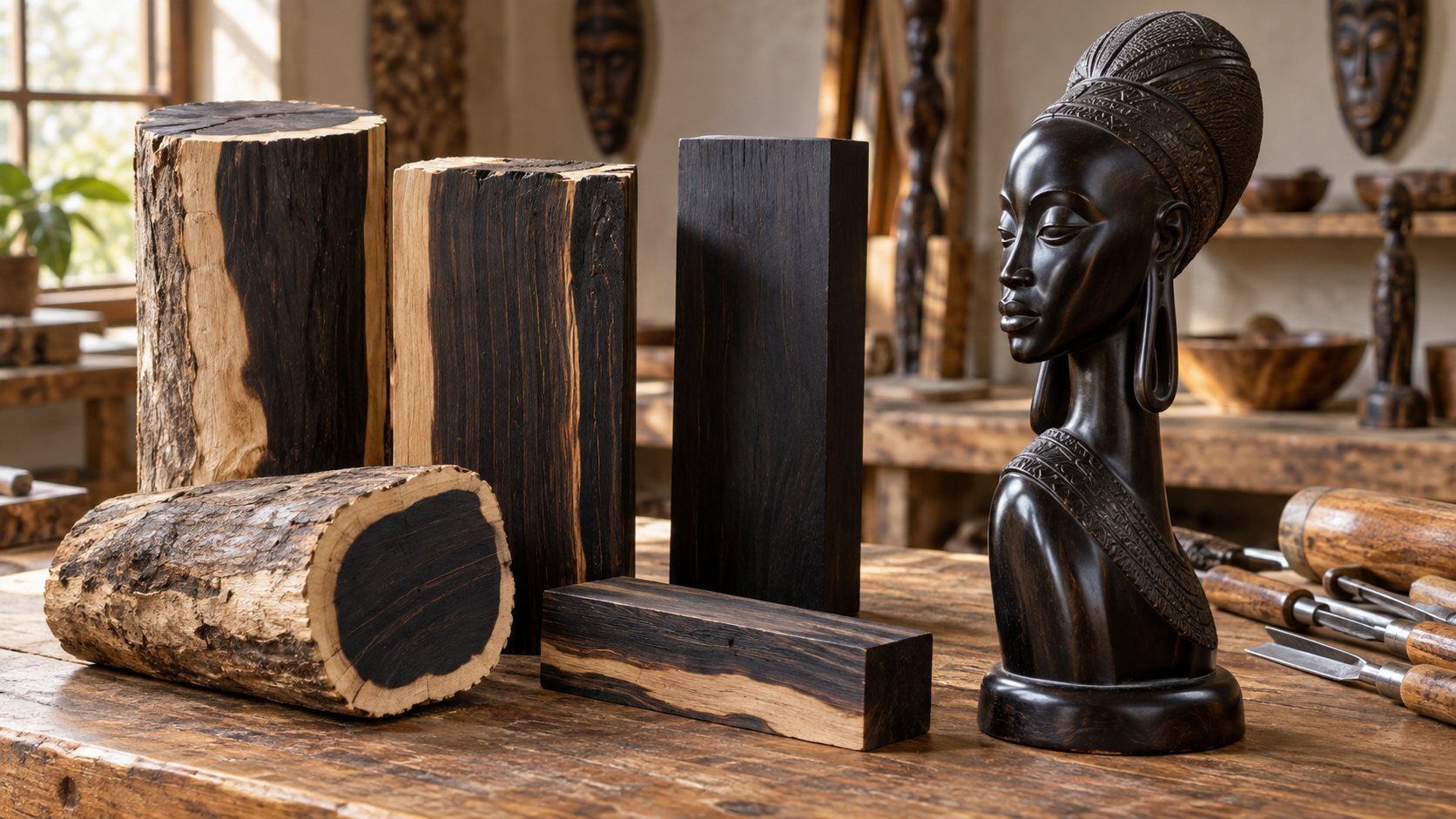
Ebony is commonly used as a colour word, yet the material comes from several trees in the Diospyros genus. Woods sold under the same commercial name can differ in origin, grain and tone. Gabon ebony, often associated with Central Africa, is known for very dark heartwood, but a real board may also carry brown streaks or a pale sapwood edge. Those variations are not automatically defects. They record the growth of the tree and can become an expressive part of a sculpture. A responsible description should identify the trade name, country of origin and botanical species whenever that information can be verified.
Colour, grain and surprising weight
The first impression is usually darkness, but ebony is defined by more than black colour. Its pores are fine, its grain can be exceptionally close, and a polished surface may reflect light almost like stone. Dense ebony also feels heavy for its size. Weight alone, however, cannot prove identity because other hardwoods can be dense and any wood can be stained. Look for consistent grain around edges, underneath the base and in less polished recesses. Subtle transitions from black to warm brown are natural. A surface that is perfectly uniform, heavily coated and impossible to inspect should invite questions rather than instant confidence.
Why carvers value the material
A sculptor needs a material that will hold the edge of an eyelid, the curve of a finger and a narrow bridge of wood between two forms. Properly seasoned ebony can preserve those details with remarkable clarity. Its hardness also makes the work demanding: tools dull quickly, cutting against the grain can chip an edge, and rushing the removal of mass can release internal tension. The value of a finished piece therefore comes from more than raw timber. It includes selection, seasoning, tool control, gradual carving and patient finishing. The finest surfaces reveal the form and natural grain instead of burying both under thick lacquer or opaque colour.
A text-free editorial image created specifically for this Africa Ebony journal story.
Ebony and other dark African woods
Wenge, African blackwood and stained hardwood are sometimes confused with ebony in photographs. Wenge generally shows stronger linear striping. African blackwood belongs to a different botanical group and can display a very dark brown or purplish cast. Ebony often appears finer and more visually continuous, although nature does not follow a fixed colour chart. A definitive species identification may require microscopic expertise, so buyers should use several pieces of evidence together: documented origin, weight, end grain, continuity of figure, quality of carving and the seller’s record. “Pure black” is a marketing phrase, not a scientific test.
Rarity changes the meaning of ownership
Slow growth, historic extraction and poorly controlled trade have placed pressure on some ebony populations. That makes provenance part of the artistic value. Reclaimed timber, documented old stock and legally sourced material with a traceable chain can be better choices than newly cut wood of uncertain origin. Regulations vary by species, country and date, so international buyers should check current official requirements before shipping. A smaller, beautifully carved object made from documented material may carry greater cultural and environmental value than a large piece with no story beyond a sales claim.
How to judge a finished sculpture
View the work from every side. Follow the balance of the silhouette, the transition between planes, the stability of the base and the cleanliness of narrow spaces. Raking light can reveal sanding waves, filled areas and cracks. A stable hairline check is not always catastrophic, but an active opening needs attention. Ask for high-resolution photographs of the front, back, side and underside, plus precise dimensions and weight. The strongest purchase brings three things into alignment: convincing material, accomplished craftsmanship and transparent provenance.
A practical checklist for collectors
Read the listing twice: first for form, then for facts. On the first pass, consider silhouette, proportion, centre of gravity, negative space and the way the sculpture changes across viewpoints. On the second, record dimensions, weight, wood description, maker or workshop, country of production, finish, condition and every stated repair. A single front image is never enough. Request the reverse, underside, side profiles and a close view under soft light. If words and photographs do not agree, resolve the difference before payment. This short discipline prevents impulse purchases and makes comparison fair.
After delivery, open the package without pulling on narrow details. Match the inventory number, measurements and condition with the invoice, then make a clear photographic record in indirect daylight. Place the work on a stable surface away from sun, heating, air conditioning and local moisture. For routine cleaning, use only a soft dry brush or clean microfibre cloth unless the maker or a conservator specifies otherwise. Keep the invoice, certificate, permits, photographs and provenance correspondence together. That file becomes part of the object’s history and supports future care, insurance or transfer.
Before you decide: look slowly and ask clearly
Ebony sculpture rewards slow looking. Begin at a distance, where the silhouette and balance are easiest to judge, and then move closer to read the meeting of planes, the direction of grain and the evidence of tools. Turn the work mentally through the photographs rather than treating the front as the entire sculpture. Notice whether a polished highlight clarifies volume or merely hides an uneven surface. Small natural variations can make an object more individual, but every crack, repair, separate component and applied coating should be described honestly. If the seller cannot answer a technical question immediately, a careful follow-up is more reassuring than an invented certainty.
Also consider the life the object will have after purchase. Identify a stable display position, measure it, check the light through a full day and plan how the piece will be lifted and dusted. Think about whether the scale suits the room and whether the subject will still hold your attention when decorative trends change. Good collecting connects visual pleasure with stewardship. It supports identifiable makers, respects finite material and preserves records that allow a future owner to understand what the object is. The strongest choice is rarely the one with the loudest story. It is the sculpture whose material, workmanship, documented origin and emotional presence remain convincing when examined together.
Frequently asked questions
Does a perfectly black colour prove that the wood is ebony?
No. Colour is only one clue. It must be considered alongside grain, density, the underside, finish, maker information and provenance. Other woods can be stained, while genuine ebony may contain brown or pale variation.
Are small surface variations defects?
Not necessarily. Natural figure, controlled tool marks and slight handmade asymmetry belong to wood and handwork. An active crack, loose joint or sticky coating is different and deserves investigation.
What documents should accompany the work?
At minimum, retain an invoice and object record stating title, maker or workshop, place of manufacture, material, dimensions, weight, unique identifier and known provenance. International movement may require additional current permits.
Editorial note: Species status and timber-trade rules vary by origin and can change. Consult current official sources and a responsible seller before international shipment.