
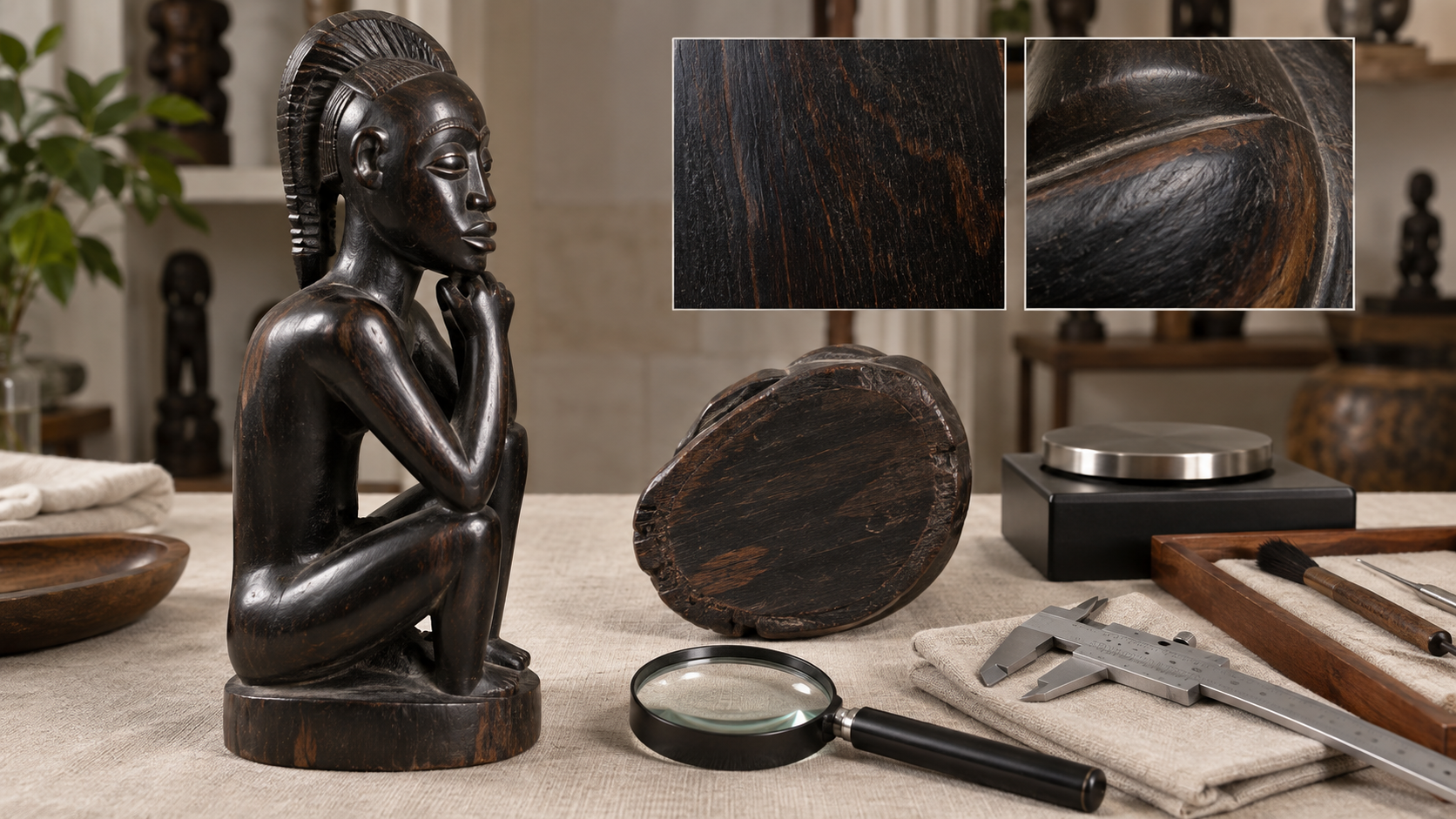
7 Signs That Help Identify an Authentic Ebony Sculpture brings material, craftsmanship and responsible collecting into one practical guide. It replaces generic claims with observable details and useful questions.
1. Compare weight with size
Ebony is generally dense, so a solid piece often feels surprisingly heavy. This is a clue, not a verdict. Other hardwoods are dense, while some sculptures are intentionally hollowed to control checking or reduce shipping weight. Ask for an exact measurement rather than “very heavy,” and compare it with the dimensions and construction. A notably light object deserves explanation, but no responsible seller should present weight as a stand-alone laboratory test.
2. Inspect the underside and recesses
Stain and opaque finish often collect in corners or fail to reach hidden surfaces evenly. The underside, drill openings and deep recesses may reveal the original colour and pore structure. Real ebony can include pale sapwood and brown streaking, so colour variation is not proof of deception. What matters is whether grain continues naturally around adjoining planes. Request an unfiltered photograph of the base before relying on a polished front view.
3. Follow the grain around the form
A natural line should continue plausibly from one face of the sculpture to another. Dye may make pores unnaturally uniform or gather at the bottom of carved channels. Even very dark ebony usually reveals subtle figure under soft raking light. High-resolution images are essential; dramatic contrast and black backgrounds can conceal rather than clarify. Ask to see the face, hands, base and one minimally finished area close up.
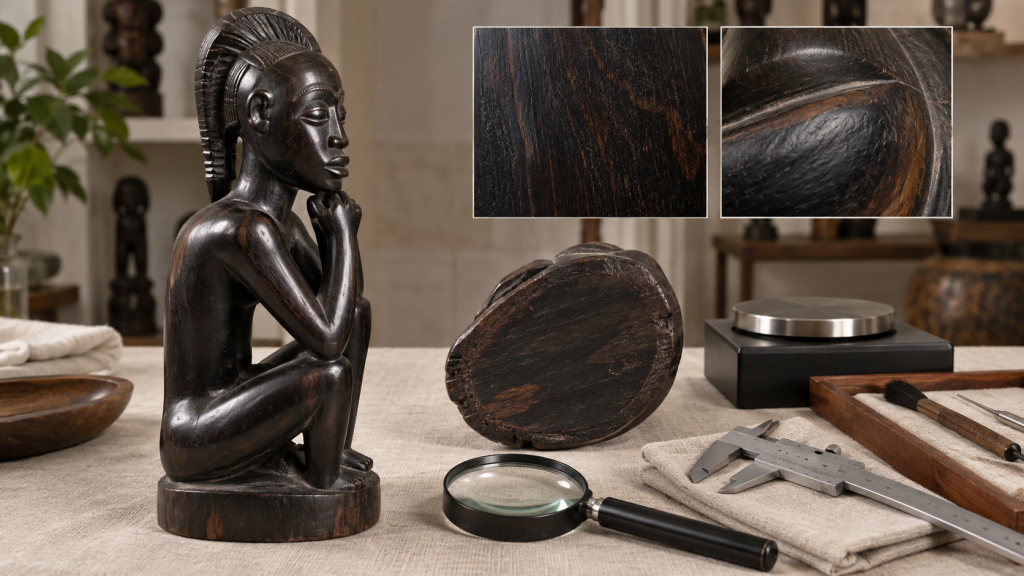
A text-free editorial image created specifically for this Africa Ebony journal story.
4. Ask about the finish—do not scratch it
Scratching, using solvent or rubbing with a wet cloth can permanently damage an artwork. Ask whether the surface contains wax, drying oil, lacquer, stain or another coating. A thick glossy finish may hide grain, but it does not automatically prove that the wood is false. What matters is accurate disclosure. A persistent chemical smell, sticky surface or colour transfer is a reason to pause and seek specialist advice rather than experiment.
5. Judge carving separately from species
Even genuine ebony does not make weak sculpture valuable. Study proportion, balance, transitions and the finish of negative spaces. Cast resin may show mould seams, repeated bubbles or identical details across multiple copies. Hand carving usually carries small, logical variation. Avoid romanticising poor work: broken edges, excess glue and uncontrolled sanding should be disclosed and reflected in price. Material and craftsmanship are two different questions.
6 and 7. Provenance and believable price
The strongest evidence is often a chain of information: maker, workshop, place, date, timber source and ownership history. International movement may require species-specific documents. A very low price for a large, flawless, solid-ebony object deserves explanation because rare wood, seasoning, tool wear and skilled labour all cost money. A high price proves nothing by itself. Confidence comes when physical evidence, clear photographs, credible documentation, return terms and the seller’s conduct all support the same account.
A practical checklist for collectors
Read the listing twice: first for form, then for facts. On the first pass, consider silhouette, proportion, centre of gravity, negative space and the way the sculpture changes across viewpoints. On the second, record dimensions, weight, wood description, maker or workshop, country of production, finish, condition and every stated repair. A single front image is never enough. Request the reverse, underside, side profiles and a close view under soft light. If words and photographs do not agree, resolve the difference before payment. This short discipline prevents impulse purchases and makes comparison fair.
After delivery, open the package without pulling on narrow details. Match the inventory number, measurements and condition with the invoice, then make a clear photographic record in indirect daylight. Place the work on a stable surface away from sun, heating, air conditioning and local moisture. For routine cleaning, use only a soft dry brush or clean microfibre cloth unless the maker or a conservator specifies otherwise. Keep the invoice, certificate, permits, photographs and provenance correspondence together. That file becomes part of the object’s history and supports future care, insurance or transfer.
Before you decide: look slowly and ask clearly
Ebony sculpture rewards slow looking. Begin at a distance, where the silhouette and balance are easiest to judge, and then move closer to read the meeting of planes, the direction of grain and the evidence of tools. Turn the work mentally through the photographs rather than treating the front as the entire sculpture. Notice whether a polished highlight clarifies volume or merely hides an uneven surface. Small natural variations can make an object more individual, but every crack, repair, separate component and applied coating should be described honestly. If the seller cannot answer a technical question immediately, a careful follow-up is more reassuring than an invented certainty.
Also consider the life the object will have after purchase. Identify a stable display position, measure it, check the light through a full day and plan how the piece will be lifted and dusted. Think about whether the scale suits the room and whether the subject will still hold your attention when decorative trends change. Good collecting connects visual pleasure with stewardship. It supports identifiable makers, respects finite material and preserves records that allow a future owner to understand what the object is. The strongest choice is rarely the one with the loudest story. It is the sculpture whose material, workmanship, documented origin and emotional presence remain convincing when examined together.
Frequently asked questions
Does a perfectly black colour prove that the wood is ebony?
No. Colour is only one clue. It must be considered alongside grain, density, the underside, finish, maker information and provenance. Other woods can be stained, while genuine ebony may contain brown or pale variation.
Are small surface variations defects?
Not necessarily. Natural figure, controlled tool marks and slight handmade asymmetry belong to wood and handwork. An active crack, loose joint or sticky coating is different and deserves investigation.
What documents should accompany the work?
At minimum, retain an invoice and object record stating title, maker or workshop, place of manufacture, material, dimensions, weight, unique identifier and known provenance. International movement may require additional current permits.
Editorial note: Species status and timber-trade rules vary by origin and can change. Consult current official sources and a responsible seller before international shipment.